The Key Stages of a Market Research Project
Launching a new product or expanding into a new market can feel like a leap into the unknown. For companies in construction, building products, and related industries, the risks are high — getting the wrong insight can mean costly missteps. A structured B2B market research project reduces that risk, giving you evidence-based insights into customer needs, competitor activity, and the best routes to market.
This guide walks through the key stages of a B2B market research project, with practical examples from sectors like flooring, modern methods of construction (MMC), and energy.
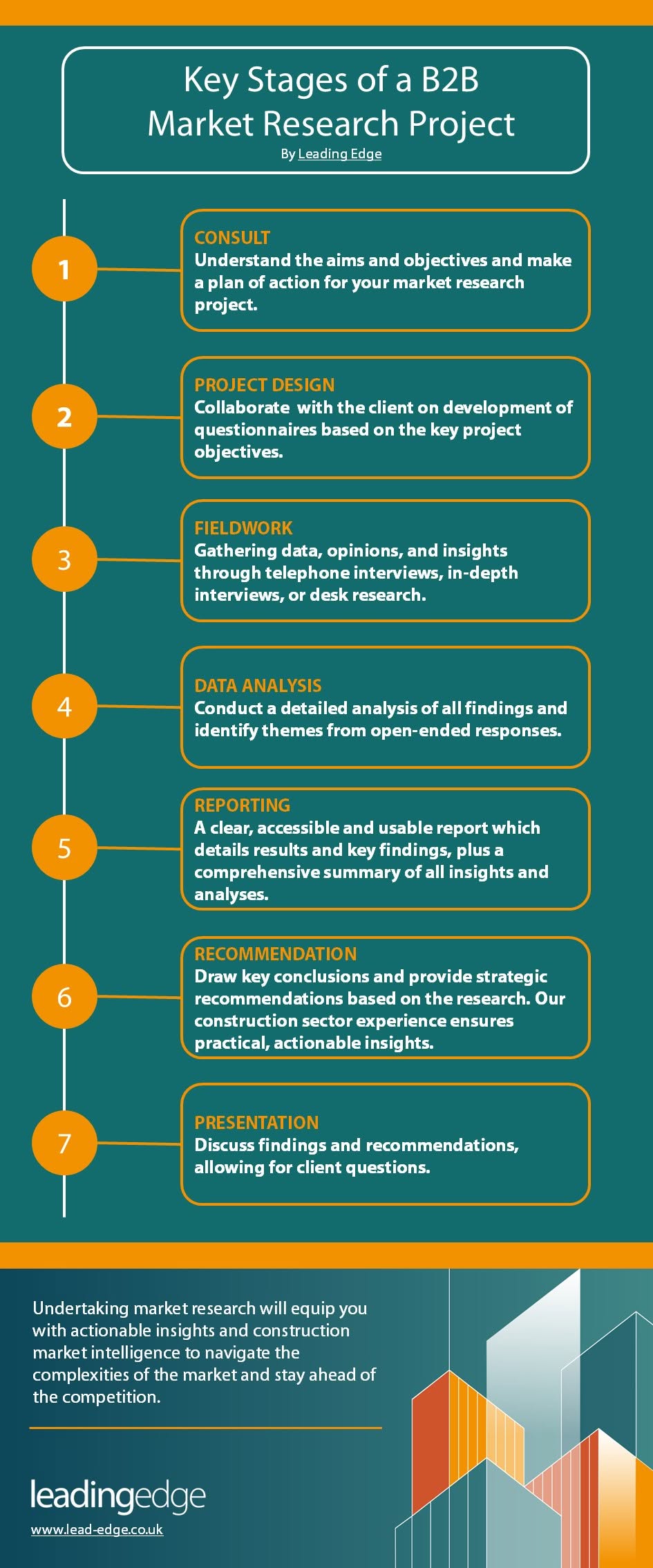
Stage 1: Define Clear Objectives
Every successful project starts with clarity. Ask:
- What business decisions will this research support?
- Do you need to size a market, assess competitor share, or understand decision-makers?
- Is the goal to explore a new sector (e.g., sports flooring) or deepen relationships with existing customers?
Example: A flooring manufacturer wanted to know why specifiers chose competitor products over theirs. By setting a clear objective (“understand buying behaviour and influencers”), the research stayed focused and actionable.
Stage 2: Research Design
With objectives in place, design the project around the right mix of methods:
- Qualitative: In-depth interviews with architects, contractors, or distributors uncover motivations and pain points.
- Quantitative: Online or telephone surveys provide measurable data on satisfaction, awareness, or volumes sold.
- Desk Research: Reviewing published reports, competitor websites, and distribution channels to set context.
At this stage, it’s important to agree the questionnaire or discussion guide. Iteration with your internal team ensures the wording captures exactly what you need.
Stage 3: Sampling and Recruitment
Getting the right voices is essential.
- Who influences specification? Architects, designers, sustainability managers?
- Which contractors or installers shape final product choice?
- Should you include both customers and non-customers for a balanced view?
Tip: In niche sectors, recruitment often needs tailored approaches. For example, steel fabricators may need to be included in balcony research because they design the cantilever systems.
Stage 4: Data Collection
This is where insights come to life.
- Interviews (telephone or Teams) allow depth and flexibility.
- Online surveys are cost-effective for reaching larger groups.
- Focus groups can explore perceptions of new product concepts.
Quality matters: double-check questions are clear, responses are complete, and quotas are balanced.
Stage 5: Analysis and Interpretation
Data without interpretation is just numbers.
- Identify patterns: e.g., which features drive product choice?
- Compare customers vs. non-customers to spot opportunities.
- Look at segmentation: housebuilders, facilities management contractors, or housing associations may all have different priorities.
Visual outputs (charts, dashboards) make findings easier to digest.
Stage 6: Reporting and Recommendations
The final stage is more than presenting data — it’s telling the story.
- Summarise key findings with a clear narrative.
- Highlight strengths, areas for improvement, and opportunities.
- Provide actionable recommendations: e.g., improve distributor support, tailor messaging for sustainability managers, or refine product positioning.
Example: In one project, analysis showed specifiers relied heavily on just two competitor brands. The recommendation was to reposition the client as a high-quality alternative, supported by targeted marketing to architects.
FAQs
How long does a typical B2B market research project take?
Anywhere from 4–10 weeks depending on scope, audience, and sample size.
What budget do I need?
Budgets vary. A small qualitative project may start at a few thousand pounds, while large quantitative studies can be more substantial.
What mistakes should I avoid?
- Ignoring non-customers who can reveal why you’re not being chosen.
- Starting without clear objectives.
- Asking too many questions (leading to drop-off).
Conclusion
A structured market research project helps you reduce risk, improve decision-making, and understand your customers in depth. Whether you’re developing new products, entering the UK market, or testing your performance against competitors, following these stages ensures the insights you gain are both robust and actionable.
How Leading Edge Supports Your Market Research Journey
With extensive experience in the construction sector, Leading Edge specializes in delivering market intelligence tailored to your needs. Our expertise spans every stage of the research process, ensuring you receive actionable insights that drive results.
Whether you’re entering a new market, launching a product, or seeking to understand customer behaviors, we provide the tools and guidance to navigate the complexities with confidence.
Ready to take the first step? Why not have a look at our whitepapers in the Downloads section of our website.
Contact our team at Leading Edge today to discuss your next market research project.
Embed This On To You Website
To embed this on to your website, please use the following embed code. Attribution is required, along with a link to Leading Edge. No alterations to the infographic are allowed:
<br /> <p><strong>Infographic created by <a href=”https://lead-edge.co.uk”>Leading Edge</a>:</strong></p><br /> <p><a href=”https://lead-edge.co.uk/articles/the-key-stages-of-a-b2b-market-research-project/”><img src=”https://cdn.lead-edge.co.uk/wp-content/uploads/infographics/LE-infographic-stages-of-a-market-research-project.jpg” alt=”Leading Edge Key Stages of a Construction Market Research Project Infographic” width=”945″ /></a></p></p>